Her late mother's will said the sapphire necklace was hers. Her stepmother was wearing it by the pool. When her father finally said "give it back," the stepmother threw it in the water. But the necklace that came up from the bottom was not the one her mother wore.
The lawyer's envelope had come that morning.
Sophia Ortiz read it three times in her car outside her father's house in Coral Gables before she could make herself go inside. Twenty-four years old, white linen shirt, jeans, sandals, long dark hair she still wore the way her mother used to like it. She held the paper so tight it wrinkled.
The Last Will and Testament of Elena Maria Ortiz.
Two years since the funeral. Two years of her father saying the will was "being handled." Two years of her not pushing, because he was grieving, and she didn't want to be the daughter who asked about stuff.
Then the lawyer's office called and said they'd been trying to reach her father for eighteen months. Did she want a copy?
She did.
She walked through the house, through the kitchen her mother had painted yellow, and slid open the glass door to the back patio.
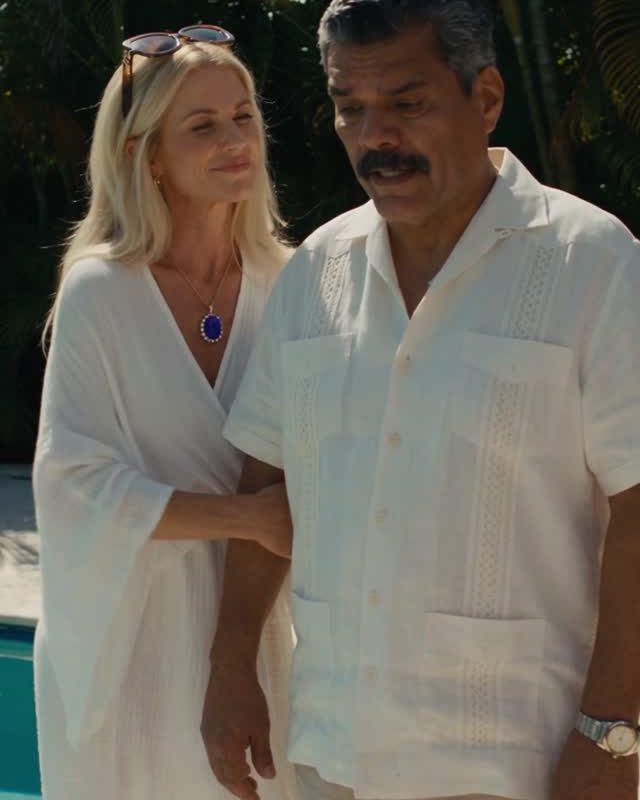
Her father, Rafael, was standing by the pool in a white guayabera and linen pants, gray hair slicked back, the gold watch her mother gave him on their twenty-fifth anniversary. And next to him, holding his arm, was Chelsea.
Forty-one. Blonde. White beach cover-up, sunglasses pushed up on her head. Married to her father for eight months.
And around her neck, on a thin gold chain, a deep blue stone the size of a grape.
Sophia stopped in the doorway.
"Is that my mom's necklace?"
Chelsea touched the stone with two fingers and smiled.
"Your father gave it to me."
Sophia looked at her father. He looked at the pool.
"Dad," she said. "You gave her Mom's things?"
Rafael finally lifted his eyes. He looked tired. Older than he should.
"Chelsea's family now," he said. "Your mom's not coming back."
Chelsea squeezed his arm and tilted her head at Sophia, sweet as sugar.
"I live here now, sweetie. Get used to it."
Sophia walked out onto the hot concrete. She held up the paper. Her hand was steady. She'd been crying in the car so she wouldn't have to cry out here.
"Mom left that necklace to me," she said. "It was never yours to give."
She held the page out so her father could see it. Paragraph seven. Typed, with her mother's signature at the bottom.
My sapphire necklace I leave to my daughter, Sophia.
Rafael read it. He read it again. Something moved across his face. Shame, maybe. Or something older than shame.
He turned to his wife.
"Chelsea," he said quietly. "Give it back."
Chelsea's smile stayed on her face. But her eyes changed.
She reached up, hooked her fingers under the gold chain, and yanked. The clasp snapped.
"Fine," she said. "Go get it."
And she threw it.
Overhand, hard, like she was throwing a ball for a dog. The necklace flashed once in the sun, hit the water in the deep end with a tiny splash, and sank. They all watched it go down. A little blue dot on the white bottom of the pool, nine feet under.
Nobody moved for a second.
Then Sophia kicked off her sandals and jumped in.
Clothes and all. White shirt, jeans, everything. She didn't think about it. The water was cold, and the bottom was a long way down, and her jeans dragged at her like weights. Her ears popped. She grabbed the chain on the first try, because she'd learned to swim in this pool. Her mother taught her. Right here. In the deep end.
She came up gasping, hair plastered across her face, the necklace in her fist.
Chelsea was already walking back into the house. "I'll be inside," she called over her shoulder. "Let me know when the drama's over."
Rafael stood at the edge of the pool, looking down at his daughter. He reached out a hand to help her up.
Sophia didn't take it. She climbed out on her own, using the ladder, dripping all over the concrete.
"Mija..."
"Don't," she said.
She opened her hand and looked at the necklace. The chain was broken. But the stone was fine. Deep blue, surrounded by tiny diamonds, the same necklace her mother wore every Christmas Eve and every anniversary and to her own daughter's high school graduation.
At least, she thought it was the same.
Sophia held it up to the sun.
Her mother used to do that. Hold it up to the light and show her. Look, mija. See the little silk inside? Like a star. That's how you know it's real.
There was no star.
The stone was blue all the way through. Clear and perfect and flat. Like glass.
The next morning, Sophia drove to a small jewelry store in Little Havana. The same store her grandfather bought that sapphire from in 1979. The same family still ran it.
Mr. Abrams was eighty-three and still came in every day. He put on his loupe, held the necklace under the lamp, and looked at it for a very long time.
Then he put it down on the velvet pad and took off his loupe.
"Sophia," he said gently. "I set your grandmother's sapphire in this pendant with my own hands. Six carats. A Ceylon stone, with a beautiful star in it."
"I know."
He tapped the blue stone with one finger.
"This is not that stone."
This is a fictional story. Names, characters and events are invented. Any resemblance to real people or events is coincidental.