The Old Man Had Fed Him First
Listen to the story
Jordan couldn't talk for a second.
He reached across the table and took the photo out of Clarence's hand. Gently. Like it might tear.
"Mr. Moore," he said.
Clarence looked up sharp. Nobody had called him that in a long time.
"How you know my name?"
Jordan put his finger on the skinny kid in the front row.
"You used to put a tray on the end of the third table. Every day. Right before the bell. You'd put a carton of chocolate milk on it, and you'd say, somebody forgot their lunch, whoever finds it can have it."
Clarence's mouth opened.
"Nobody ever forgot their lunch," Jordan said. "It was always your lunch."
Clarence stared at him. At the suit. At the watch. At the face.
"Little Jordan Hale," he whispered. "Lord have mercy. Little Jordan with the big head."
Jordan laughed, and it came out wet. "It's still big. I just grew into it."
Clarence reached out and grabbed his hand across the table, and held on.
"You made it," he said. "Look at you. You made it, son."
"Because of you." Jordan's voice broke. "Mr. Moore, I had nothing at home. You know that. Some days that tray was the only thing I ate. I always wanted to find you. I asked at the school once, after college. They said you'd retired. They didn't have an address."
"I was right here," Clarence said. "Forty years on Delmar Street. Same house."
"Not anymore," Jordan said quietly.
Clarence's grip loosened. "Not anymore."
Jordan sat back. The lawyer part of his brain clicked on, cold and clear.
"Mr. Moore. Those papers Tanya had you sign. Do you remember when?"
"March. I know because I'd just got out the hospital. My heart. I was in there four days."
"Do you remember the exact day you signed?"
Clarence thought. "The day I came home. Tanya had them on the kitchen table waiting. She had a lady there with a stamp."
A notary. Jordan wrote it down on a napkin.
"Do you still have your hospital bracelet? Discharge papers? Anything?"
Clarence dug through the white bundle and came out with a folded blue paper, soft from being handled. Discharge summary. St. Mary's Hospital. He handed it over.
Jordan read it once. Then he read it again.
Then he smiled. Not a happy smile.
"Mr. Moore, finish your food," he said. "Then we're going to go see your son."
The house on Delmar Street was small and neat. Brick, with a porch and a chain-link fence. Somebody had put new rocking chairs out front. A shiny black SUV sat in the driveway, temporary plates still taped in the back window.
Clarence stopped at the gate. "That's my rocking chair spot. That was my wife's garden."
The garden was gone. Fresh gravel.
Jordan knocked.
A man about forty opened the door. He had Clarence's eyes and none of his softness. He saw his father on the porch and his face went tight.
"Pop. I told you, you can't keep coming around here."
"Kevin Moore?" Jordan said.
"Who are you?"
"Jordan Hale. I'm your father's attorney."
A woman appeared behind Kevin. Long braids, gold hoops, phone in her hand. Tanya.
"Attorney?" she said. She laughed. "Pop, where'd you find a lawyer? At the bus station?"
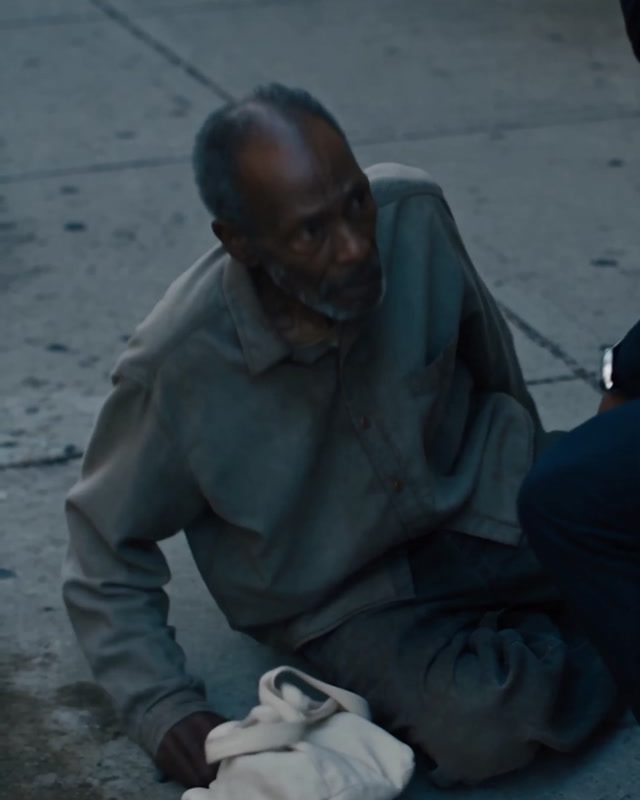
"At Sal's," Clarence said. "After the cook threw me on the sidewalk. Hungry."
Kevin had the decency to look away for a second.
Jordan didn't wait. "Mr. Moore says he never agreed to give you this house. He says Tanya told him he was signing Medicare forms."
"That's a lie," Tanya said. "He knew exactly what he was signing. He wanted us to have it."
"He couldn't read it. He didn't have his glasses."
"So? He agreed."
"Pop's confused," Kevin said quickly. "He's seventy-eight. He forgets stuff. Half the time he thinks Mama's still alive. We were trying to protect him."
Jordan turned to Clarence. "Mr. Moore, what's today's date?"
"October twelfth."
"Who's the president of the parent-teacher association at Lincoln Elementary in nineteen ninety-nine?"
"Mrs. Delores Watts. Mean as a snake, God rest her."
"What was your wife's name?"
"Annette Louise Moore. Died six years ago this January. I know she's gone, Kevin. I just like to talk to her."
Kevin didn't say anything.
Tanya crossed her arms. "It doesn't matter. The deed's signed and notarized. It's legal. It's done."
"Notarized," Jordan said. "On what day?"
"I don't know. March. Whenever."
Jordan pulled out his phone. He'd already looked it up in the car. The county records were public.
"Quitclaim deed. Signed and notarized March fourteenth. Notary: Renee Carter."
Tanya's face flickered.
"Your cousin?" Jordan asked.
She didn't answer.
He held up the soft blue paper. "This is your father-in-law's hospital discharge. St. Mary's. He was admitted March eleventh. Released March sixteenth. On March fourteenth, when he supposedly signed this deed at your kitchen table, he was in a hospital bed on the fourth floor with a heart monitor on his chest."
Kevin turned slowly and looked at his wife.
"Tanya," he said. "You told me he signed it the day he came home."
"He did," she said. "I just... I put the date wrong. That's all. Renee put the wrong date."
"A notary put the wrong date," Jordan said. "On a deed. For a house worth two hundred and ninety thousand dollars. Two days before the man was even out of the hospital."
He let her hear how it sounded.
Then he put the paper back in his pocket.
"Here's what's going to happen," Jordan said. "Tomorrow morning I'm filing to void that deed. Fraud and elder financial abuse. I'm also sending a copy to the district attorney and to the state board that licenses notaries. Renee is going to have a very bad week."
Tanya's lips pressed white.
"Or," Jordan said, "you two sign a new deed tonight giving this house back to the man who paid for it. And you move out by the end of the month."
Kevin looked at his father. For a second, he looked like a little boy.
"Pop," he said. "Are you really gonna do this to your own son?"
Clarence was quiet for a long time.
Then he said something nobody on that porch expected.
This is a fictional story. Names, characters and events are invented. Any resemblance to real people or events is coincidental.